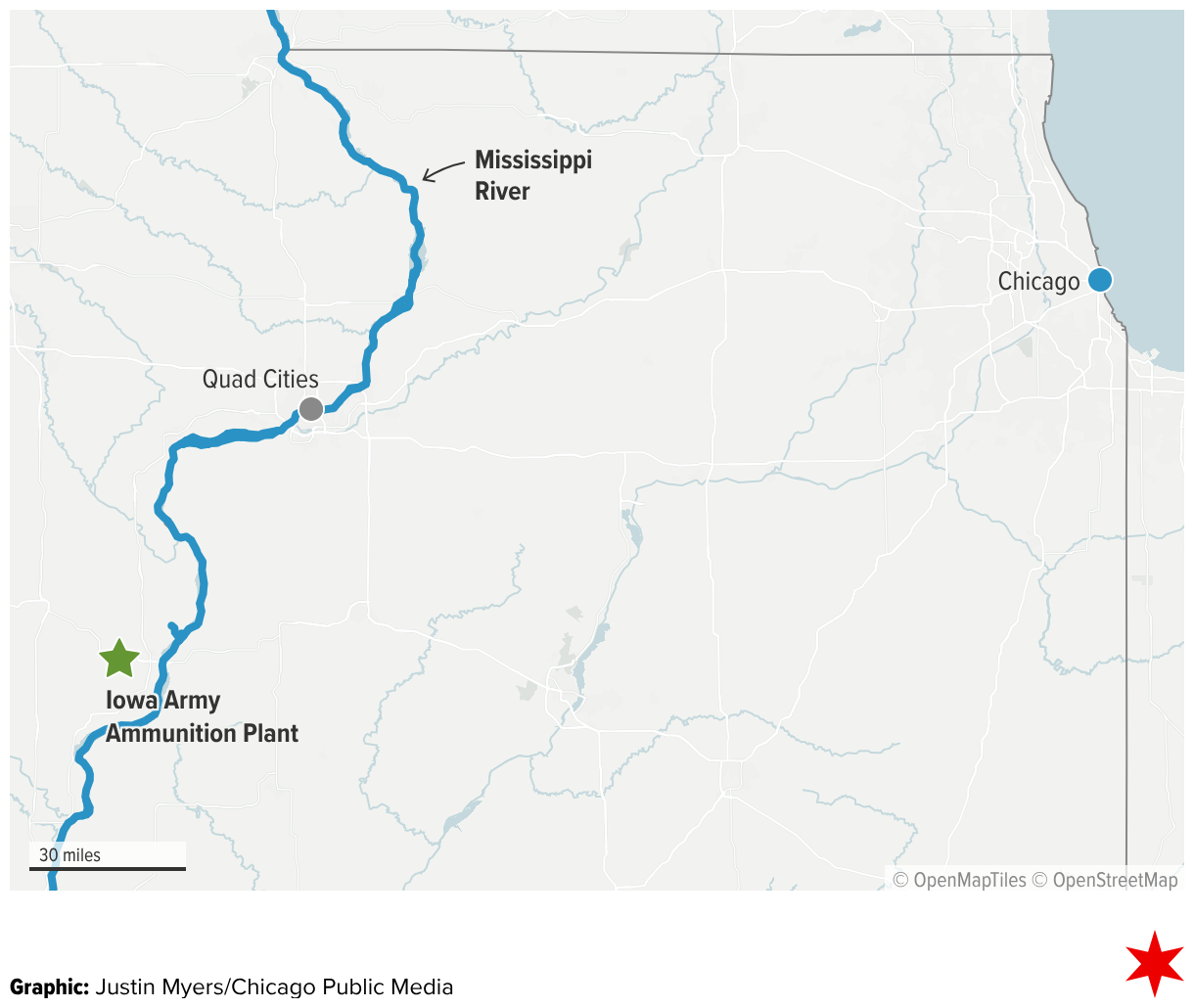
The U.S. Army is scheduled to detonate a stockpile of lead azide, a chemical used for making bombs, Monday in Middletown, Iowa, about 80 miles southwest of the Quad Cities.
The explosion is expected to create a dust plume containing lead that may cross into Illinois. Lead is toxic to humans and animals. Late Thursday, the Army moved the planned explosion from Friday to Monday after politicians from Iowa and Illinois asked for a delay.
“Public safety is the Army’s top priority,” acting secretary of the Army Adam Telle said in part of a statement posted on X. “This will delay the detonation until the latest possible moment prior to a forecasted temperature drop, which would risk further destabilization of the material.”
Here’s what else you need to know.
There’s a risk that these stored materials will detonate on their own and moving them could also trigger an explosion, according to the Defense Department. The issue was discovered earlier this year and plans to blow them up have been ongoing for months.
The detonation is expected to take place at the Iowa Army Ammunition Plant in Middletown, Iowa, Monday. The plant is around 80 miles southwest of the Quad Cities and only about 10 miles west of rural Illinois communities just across the Mississippi River.
The Army delayed the planned explosion three days after politicians raised concerns about safety. Both the outgoing Republican governor of Iowa and the newly elected Democratic governor there both called for a delay. They were joined by other politicians in both states. The environmental organization Earthjustice also sued to try to pause the detonation.
While the Army has destroyed weapons and materials in the past, it has never blown up such a large amount of this particular chemical, according to a spokesperson.
“We detonate all the time, but we have not detonated lead azide at this quantity,” said Lori McFate, public affairs specialist with the Army Sustainment Command in Bettendorf, Iowa.
McFate said the explosion will take place after months of planning. The procedure has received a green light from the U.S. Environmental Protection Agency regional office in Kansas City. That’s a different jurisdiction than the regional EPA office in Chicago, which oversees environmental protection in Illinois.
Lead azide is a compound of lead and nitrogen, used to make bombs. About 5 tons of it will be blown up Monday.
“The lead azide has aged. It's become unstable to the point where moving it or even allowing it to sit on the odd chance that it receives some sort of shock or friction could lead to a spontaneous explosion,” said Greg Domski, associate provost and professor of chemistry and biochemistry at Augustana College in Rock Island.
Illinois EPA officials say based on current air modeling conducted by the U.S. Army, the dust cloud from the detonation could come close to Mercer County in Illinois. It’s unclear whether the lead dust could blow as far northeast as Chicago. The Army will update its models prior and following the detonation, which could change what Illinois communities might be affected.
The EPA says there is no safe level of lead exposure. It is a neurotoxin that damages the central nervous system. It’s particularly harmful to children as their brains and nervous systems aren’t fully developed. Exposure to lead is associated with cognitive delays, heart problems, and reproductive issues.
“Lead is an element, and doesn't break down,” says Robert Hirschfeld, director of water policy at the Prairie River Network, a Champaign-based environmental advocacy group.
“Those health risks persist as long as the lead does.”
As part of the controlled detonation, federal officials are installing air monitors and will conduct further environmental sampling of the blast area.
The agricultural impacts of the lead dust are still unknown, according to Hirschfeld. “We’re past harvest now, and so all of that lead is going to land on bare soil and that lead will stay there and contaminate that soil,” Hirschfeld says.
He says lead contamination could go beyond the potentially impacted farmland and crops, and trickle down to animals, whether livestock or wildlife, that graze on the land.
The Illinois Department of Public Health recommends the following safety tips: